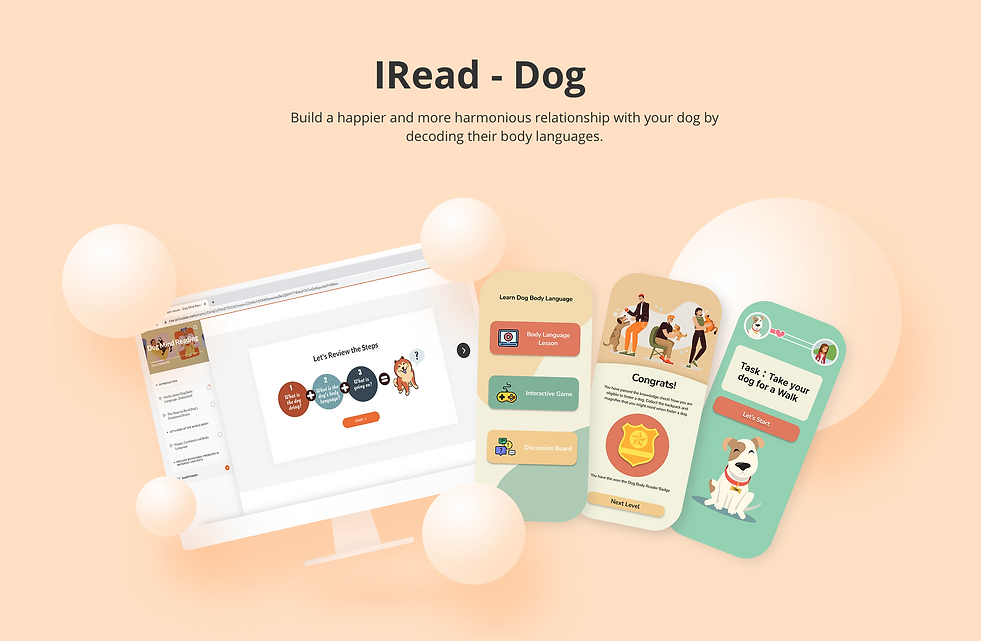
OVERVIEW
A platform to facilitate dog owners to get a full understanding of what their dogs are communicating.
Dogs are really good at picking up on our emotions while we are not. This project collaborated with four certified professional dog trainers that aim to provide a learning solution to help dog owners better understand their dogs’ messages. Compared to physical dog training classes, the I-Read Dog platform allows a more flexible and engaging learning environment by approaching the playful e-learning curriculums and the simulation game.
My Role
-
Reasearch &Analysis
-
Storyboard & Personas
-
Ideation
-
Prototyping & Testing
Teams
-
Tianyu Yang
-
Yi Lu
-
Kemeng Zhai
-
Yuhan Tan
Tools
-
Figma
-
Rise 360
-
Mural
Duration
-
Feb - May 2022
PROBLEM
The Covid-19 Pandemic sparked a boom in dog adoptions from shelters and sales from breeders while the fact is most owners are not prepared to handle the responsibility of pet ownership.
Dog ownership comes with big responsibility, and many people do not realize that. The pandemic brough many new dog owners into the pet parenting fold since human-animal interactions may enhance feelings of love and reduce stresses during social isolation. However, a survey from Merck in 2020 pointed out that over 70% of those who become dog owners that year have considered re-homing once the pandemic ended. This is likely driven by a lack of knowledge of what it takes to care for a dog. Today, reports about dog incidents are increasing and over 80% of dogs have behavioral problems. Thus, reading dogs is vital for better understanding their signals that prevent their behavioral and health problems.
STORYBOARD
I designed and drew this storyboard to help our stakeholders in comprehending the current motivations and experiences of our target users, as well as to inspire them about the significance of this issue.

DESIGN CHALLENGE
" How might we help dog owners better understand their dogs and gain insights into how their minds work?"
THE SOLUTION
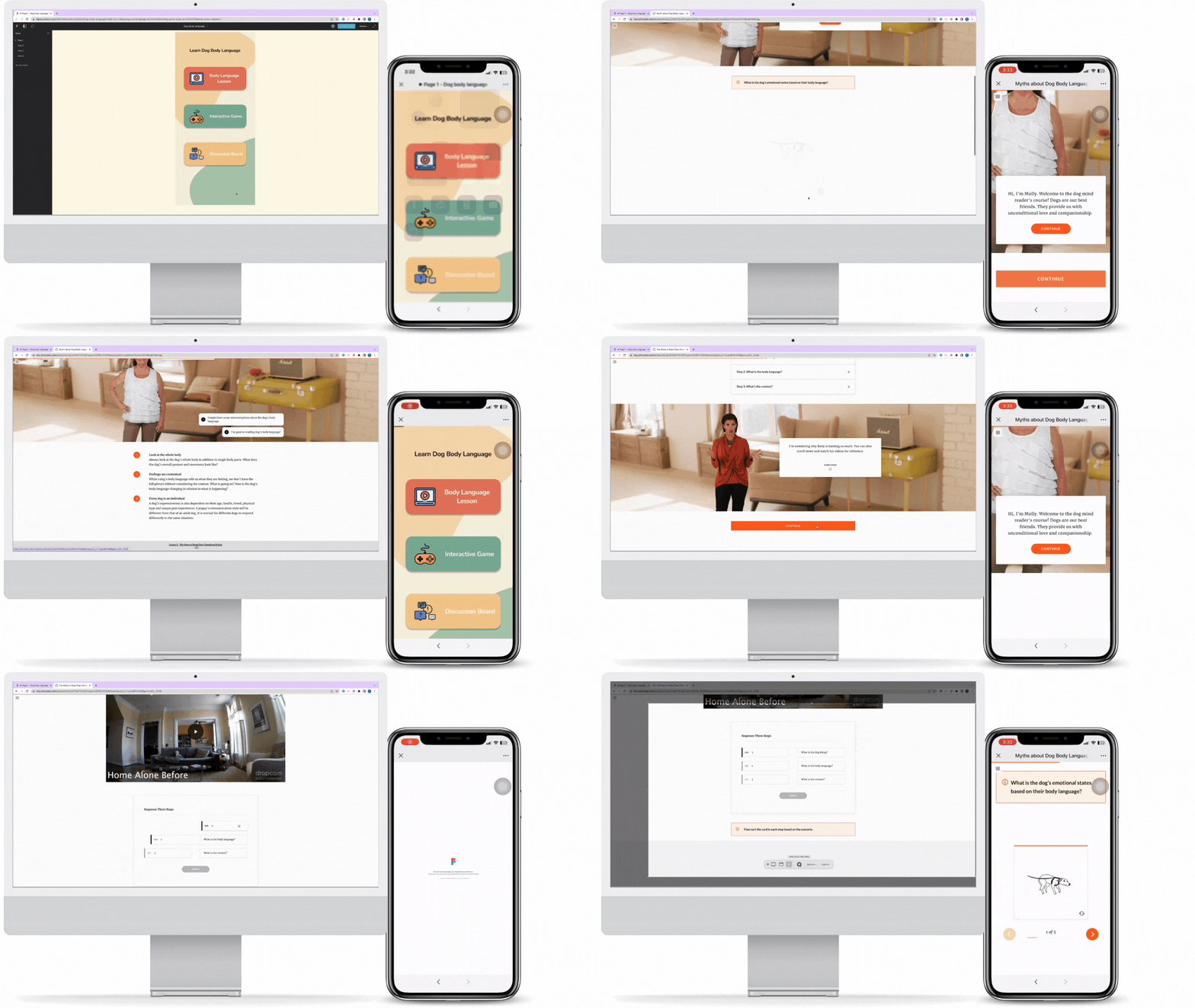
I-Read Dog: An e-learning platform that engages dog owners to better understand their dogs in a fun and effective way.
01
Online Tutorials
-
Allow the flexibility for dog owners to access different fundamental tutorials based on their preferences and situations.
-
Having interactive widgets to reinforce their comprehension.
-
Combining knowledge check to help grasp the concept.
02
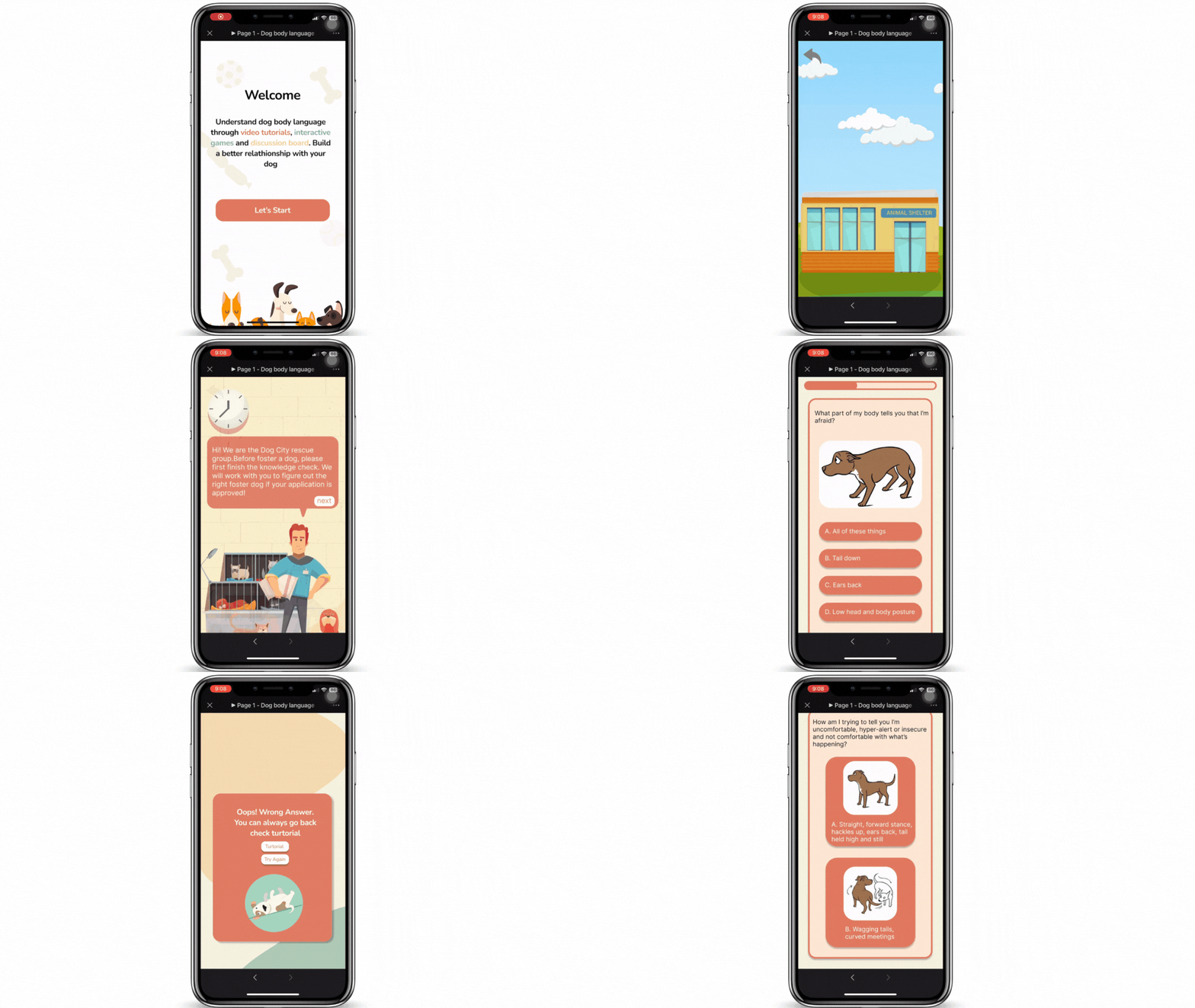
A Game-Based Setting
-
More opportunities to practice in different contexts such as in the park, at home etc.
-
Earn the badge for completing challenging tasks.
-
Guiding dog owners to read their dogs.
PROCESS
Ok, but how did we actually get there?
We decided to divide our research into two phases - a primary research phase where we understood the context of the problem, conducted Subject Matter Expert(SME) interviews and sent out a survey to collect dog owners’ behaviors and preferences.
This was followed by a Secondary research phase where we deep dived into resources including published books and articles online that SMEs recommended, and synthesized all data we have collected into an affinity map that helped us identify key insights, build personas, and inspire for design opportunities.
USER RESEARCH
The Domain Expert Interviews revealed 3 key insights of the common behaviors and attitudes of dog owners toward their dogs.
We conducted 4 interviews with certified-professional dog trainers who have been working in dog training for years to understand dog owners’ challenges and attitudes of learning dog body languages.

but our survey also revealed learners' learning preferences and areas of excitement that we could capitalize on to create engaging learning experiences.

LEARNER PERSONAS


TASK ANALYSIS
Learner Procedural Workflow of Preventing Dogs' Behavioral Problems through their Body Language

DESIGN OPPORTUNITIES
How could we translate these difficulties into design opportunities?

INITIAL DESIGN IDEAS
Given our research findings, we came up with three divergent design ideas that tackled the problem space.


IMPLEMENTATION
We ended up focusing on two ideas - tutorials and the interactive game to further prototype.

Tutorial Design
Our I- Read Dog platform helps dog owners....


Game Design
While fostering a dog, dog owners can assess and practice ...


EVALUATION
Executive Summary
We work with four individual “proxies” learners to gather data to revise the instruction. Based on the results, we remove some obvious errors and omissions in terms of usability and instructions, adjust the content to make it less overwhelming.
Purpose
-
Does every step make sense for them?
-
Can they understand what each button and page mean?
-
Did task performances align with our learning objectives and goals? (What do they learn from each task?)
-
Do we have enough content or too complicated for learners?
-
Did learners keep up with their pace or lose their patience to learn?
Methodology
Method
-
Think-aloud
-
Interview
-
Observation
Participants
-
We asked 4 classmates with varying degrees of experience of having a dog and prior knowledge of dog’s body language as the proxies for the learners.
Instruments
-
Google docs to take notes
-
Mural board to organize notes
Conclusion + Reflection
What'd we do differently next time?
For the tutorials and games, we need to find the balance between effectiveness and engagement, a.k.a. user-centered design and learning design.
Tutorials:
-
The intro part could be replaced with a video that hooks learners first. The scenario with a lot of text might lead learners lose their interest.
-
While learners prefer videos as they are more engaging, the text is particularly good at handling the linear structure of information so we use it to explain the procedure of reading a dog’s body language. The text is effective in this way but it is also overwhelming for learners without much prior knowledge. We can add videos first and then use text or interactive widgets to help learners review the procedure.
-
Content needs to be chunked.
-
Provide more autonomy for learners with different levels of prior knowledge.
Games:
-
We will correct obvious errors and omissions regarding usability.
-
Provide more actionable feedback on wrong answers.
The connection between tutorials and games:
-
In the future, we will keep both tutorials and games on the same platform.
-
We will try to make the game more interactive with wide choices.